


What Drives Q1 India Property Market Performance?
India property market Q1 transaction volume reaches ₹3.8 lakh crore up 28%. Consequently, residential sector accounts for 68% total activity across metros. Industry analysts project 11.5% total returns for 2026.

Additionally, RERA implementation improves transparency attracting institutional capital increasingly. Therefore, organized developers gain market share from unregulated players. Moreover, affordable housing schemes drive volume in tier-2 cities.
Foreign portfolio investors deploy ₹18,500 crore in REITs and InvITs. For instance, office and logistics assets attract global institutional capital. Thus, commercial real estate gains legitimacy as investable asset class.
Which Indian Cities Lead Q1 Real Estate Investment?
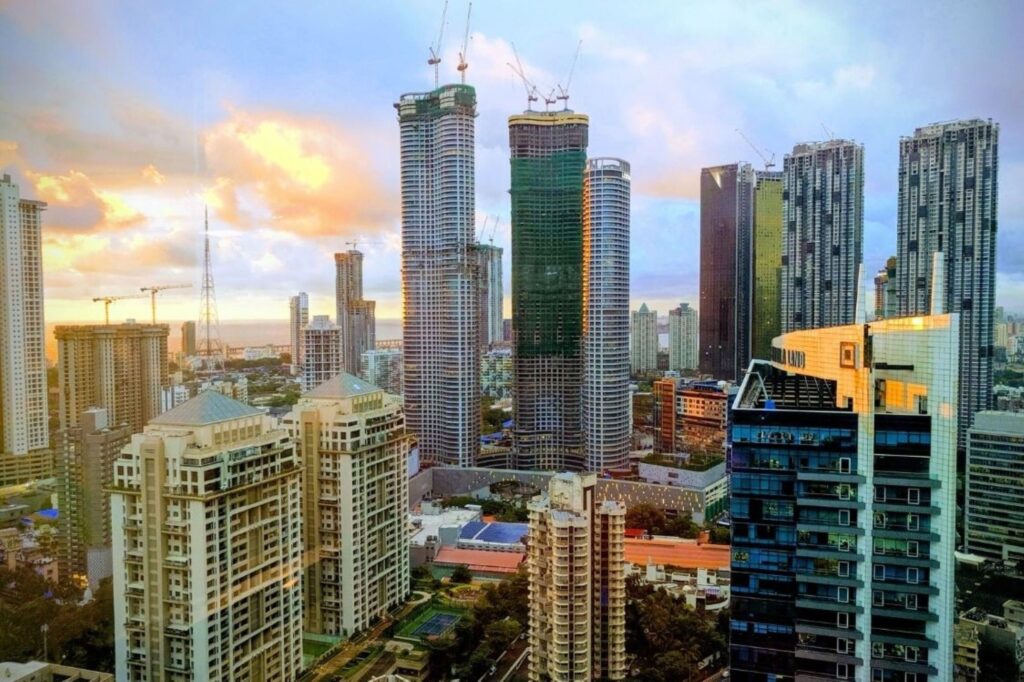
Mumbai Metropolitan Region maintains dominance with ₹85,000 crore volume. Furthermore, South Mumbai and BKC command premium office rentals. Residential prices average ₹18,000-45,000 per square foot in prime areas.
Bangalore records ₹62,000 crore activity driven by technology sector growth. However, Whitefield and Electronic City lead office absorption rates. Also, residential demand from tech professionals supports pricing stability.
Delhi NCR generates ₹58,000 crore across Gurgaon, Noida, and Greater Noida. Meanwhile, corporate relocations and infrastructure development support fundamentals. Certainly, Dwarka Expressway corridor attracts significant residential investment currently.

Pune and Hyderabad combine for ₹48,000 crore emphasizing IT parks. For example, Hinjewadi and HITEC City drive office demand. Besides, affordable housing segments show strong absorption rates.

How Do Asset Class Returns Compare Q1 2026?
Residential apartments deliver 10.8% total returns in metro cities. Nevertheless, affordable housing segment (₹25-45 lakh) shows strongest momentum. Specifically, ready-to-move inventory outperforms under-construction projects by 4-5%.


Office spaces generate 12.5% returns concentrated in Grade A buildings. On the other hand, co-working spaces and flexible offices command premium. Additionally, ESG-certified buildings attract multinational corporations preferentially.
Retail properties achieve 8.2% returns with mall occupancies recovering post-pandemic. For instance, food and entertainment anchors drive footfall consistently. Besides, high street retail in prime locations maintains stability.
Warehousing and logistics show 14.8% returns leading all sectors. Thus, e-commerce growth and supply chain optimization drive demand. Furthermore, Grade A warehouses near ports command premium rentals.


Onam festival: Kerala’s harvest goes global
Onam festival is no longer just Kerala's harvest celebration. It is a 10-day global ritual of homecoming, plant-based eating, mindful...

Kerala retreats for Ayurvedic reset
Kerala retreats during Onam season offer something rare: the chance to celebrate one of India's most beloved festivals while undergoing...

Zero-chemical cleaning kit for Indian homes
A zero-chemical cleaning kit does not require a specialty store or a large budget. India's own kitchen shelves hold 5...

Carnatic music: a complete beginner’s guide
Carnatic music is one of South India's most profound classical traditions, built around ragas, rhythm, and centuries of devotional composition....
Which Trends Shape Investment Strategies and Returns?
REIT expansion with four new listings planned 2026 democratizing access. Therefore, retail investors gaining exposure to commercial real estate. Currently, existing REITs deliver 7-9% distribution yields consistently.
Affordable housing focus under PMAY scheme offering tax benefits and subsidies. As a result, developers launching projects ₹25-45 lakh price range. Moreover, government incentives reduce effective buyer costs 15-20%.
PropTech adoption accelerating through virtual tours and digital transactions. Indeed, online platforms facilitate 35% residential transactions currently. Also, blockchain-based registrations piloting in select states.
Sustainable buildings with IGBC and LEED certifications commanding 12-18% premiums. Nevertheless, energy-efficient buildings reduce operating costs attracting corporates. Specifically, green building stock reaches 8% total inventory.
Co-living and co-working catering to millennials and gig economy workers. Meanwhile, managed spaces offer higher yields than traditional rentals. Certainly, institutional investors entering these segments through platforms.
Smart cities development across 100 cities creating infrastructure-led appreciation zones. Thus, Amaravati, GIFT City, and Naya Raipur attract investments. Furthermore, government land auctions provide entry opportunities strategically.








A comprehensive and data-driven analysis of the Indian property market’s performance in Q1 2026. This report clearly illustrates that real estate in India has moved beyond being a traditional asset class to become a sophisticated, high-yield pillar of the modern investment portfolio.
It is particularly insightful to see the robust growth in ‘Managed Office Spaces’ and the surge in residential demand within the luxury segment. The shift toward ‘Fractional Ownership’ is a game-changer, as it democratizes access to Grade-A commercial assets, allowing a broader base of investors to benefit from stable rental yields and long-term capital appreciation. Furthermore, your breakdown of the impact of stabilized interest rates and pro-investment regulatory frameworks highlights the maturity of the Indian regulatory ecosystem.
In 2026, the ‘Tier 2 City Boom’ is no longer just a trend but a fundamental structural shift in the nation’s economic geography. Thank you for this rigorous synthesis of market dynamics. This is an essential roadmap for institutional investors and individual stakeholders looking to navigate the complexities of the Indian real estate cycle with confidence and strategic foresight.
The 18,500 crore deployment into REITs and InvITs by foreign portfolio investors is the most underrated number in the entire piece.